Technology · Access and inclusion · Digital divide
Brio and BRTN Are Building a Minority-Owned Media Alternative — But Will the Community Support It?
A new partnership between Brio, a Black-owned media company, and BRTN, the Broadcast Television and Radio Network, is attempting something Black America has talked about for decades but rarely been able to sustain at scale: building and controlling its own media distribution infrastructure.
The Black Wall Street Economy newsroom · August 12, 2026 · Reporting by The Black Wall Street Economy
The ambition is significant.
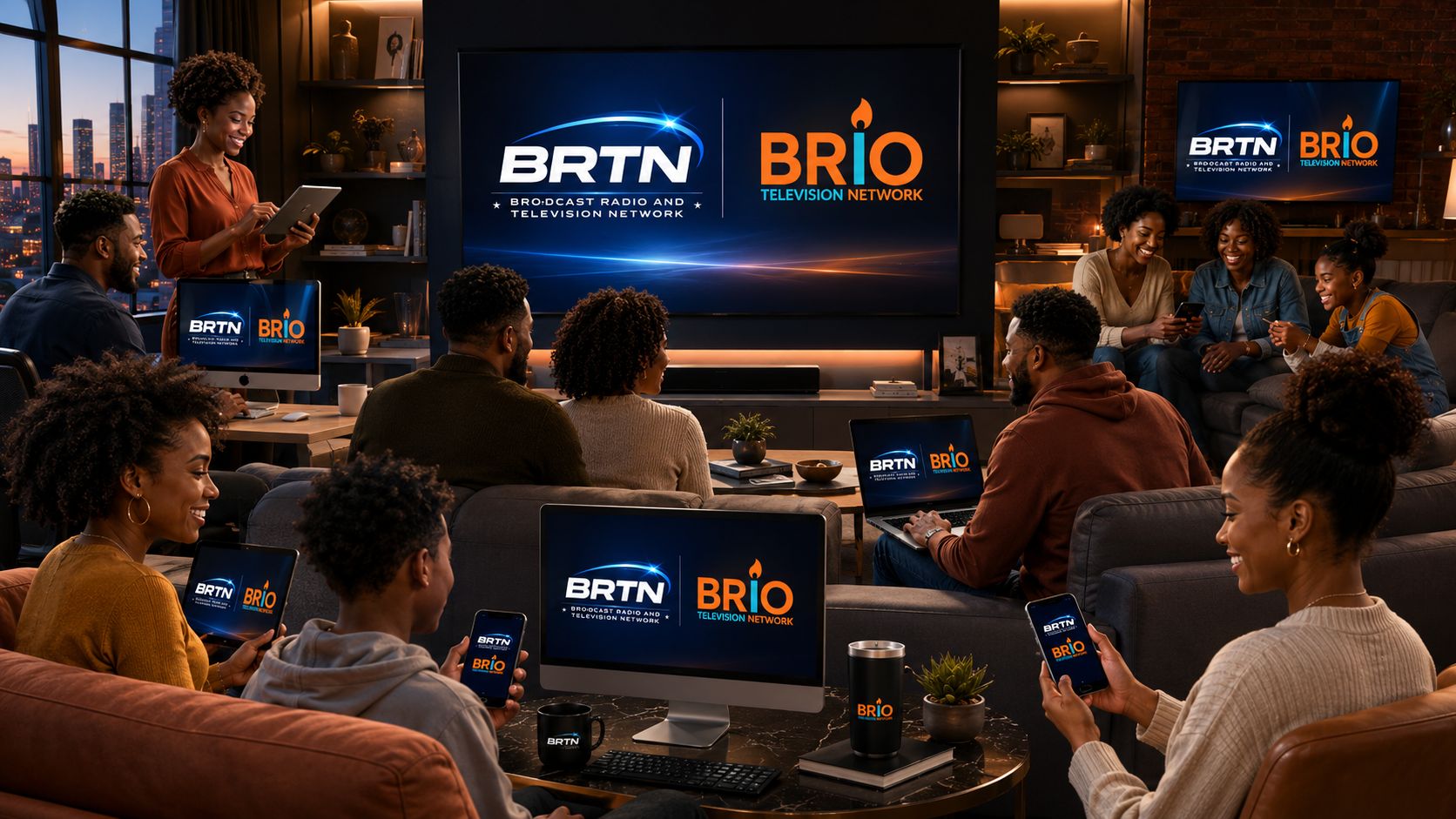
Brio and BRTN are working together to build a media community positioned as a minority-owned alternative in a marketplace dominated by giant platforms such as Roku and Amazon Prime.
BRTN describes itself as a unified broadcasting platform combining live television, video on demand and live radio, with distribution designed for smart televisions, mobile devices and the web. Its stated mission is to create a broader media ecosystem for creators, broadcasters and entrepreneurs rather than functioning simply as another streaming application.
That makes the Brio-BRTN relationship potentially more important than another programming partnership.
It raises an economic question:
Can Black and minority communities move from merely consuming media to owning the platforms through which media is distributed?
Why This Matters
For decades, minority media companies have faced the same fundamental problem.
They can create content.
They can develop audiences.
They can produce television shows, movies, news, music and documentaries.
But the distribution system is frequently controlled by somebody else.
A filmmaker may own a movie but still depend on another company to reach millions of televisions.
A television network may produce its own programming but remain dependent on cable companies for carriage.
An independent publisher may create content but rely on social-media algorithms controlled by corporations worth hundreds of billions of dollars.
That distinction—between content ownership and distribution ownership—is enormous.
The company controlling the distribution platform controls access to the customer.
And whoever controls access to the customer possesses tremendous economic power.
That is what makes the development of BRTN potentially significant to the Black Wall Street Economy.
Instead of simply asking Black filmmakers, broadcasters and entrepreneurs to create content for someone else's platform, the larger goal is to build infrastructure where minority creators can potentially distribute, advertise, monetize and develop audiences within an ecosystem in which they have a greater stake.
The Roku and Amazon Prime Question
Nobody should misunderstand the scale of the challenge.
Roku and Amazon are enormous corporations with massive customer bases, technology infrastructure, advertising businesses and billions of dollars available for expansion.
A minority-owned company does not compete against organizations of that scale simply by launching another application.
It competes by creating something those companies cannot easily duplicate:
community.
BRTN does not necessarily need to become bigger than Roku to matter.
It needs to become valuable enough that viewers intentionally choose to use it.
It needs creators.
It needs local television stations.
It needs independent filmmakers.
It needs churches.
It needs businesses.
It needs journalists.
It needs musicians.
It needs sports programming.
It needs documentaries.
It needs educational programming.
And ultimately, it needs viewers who understand that where they spend their attention has economic consequences.
A television network without viewers is simply technology.
A television network with an organized community behind it becomes an economic institution.
Black America Has Been Down This Road Before
The history of Black media ownership demonstrates why this conversation is so important.
Robert L. Johnson and Sheila Johnson founded Black Entertainment Television in 1980. BET became the first Black-controlled company listed on the New York Stock Exchange and eventually grew into one of the most recognizable media brands targeting Black audiences.
In 2000, Robert Johnson led the agreement to sell BET to Viacom in a transaction valued at approximately $3 billion; the transaction closed in 2001. The deal made Johnson America's first Black billionaire.
There is an important correction to a story sometimes repeated about BET: the documented record does not show Sheila Johnson secretly selling BET from under Robert Johnson. Robert Johnson led the Viacom sale, while Sheila Johnson was the company's co-founder and his wife at the time.
But the larger economic concern remains legitimate.
When BET was sold, Black America gained a Black billionaire—but lost controlling ownership of its largest Black-targeted television network.
At the time, Radio One founder Cathy Hughes publicly described the transaction as both a tremendous achievement for Robert Johnson and a significant loss of African American ownership.
That tension still exists today.
Is the objective to build Black companies that eventually become acquisition targets—or to build Black-controlled institutions that remain under community ownership for generations?
Those are two very different economic strategies.
The Byron Allen Example
Media entrepreneur Byron Allen represents another side of this struggle.
Allen built Entertainment Studios and later expanded Allen Media Group into television stations, cable networks and other media assets.
But his expansion has repeatedly brought him into conflict with some of America's largest corporations over advertising dollars and television distribution.
One of the most significant battles reached the U.S. Supreme Court.
Allen's Entertainment Studios alleged that Comcast discriminated against his Black-owned networks by refusing carriage agreements. Comcast denied racial discrimination and argued that legitimate business considerations drove its decisions.
In 2020, the Supreme Court ruled that a plaintiff bringing a claim under the relevant federal civil-rights statute had to demonstrate that race was the “but-for” cause of the contractual injury.
Whatever someone's position on that lawsuit, it demonstrates a fundamental reality:
Owning content is one thing. Getting powerful gatekeepers to distribute that content is another.
That is precisely why controlling distribution infrastructure matters.
And Then There Is Bill Cosby
Another story frequently raised in discussions of Black media ownership involves Bill Cosby.
During the early 1990s, Cosby seriously explored purchasing NBC—not ABC, as the story is sometimes repeated.
Contemporary reporting described Cosby assembling advisers and financial backing for a potential multibillion-dollar effort to acquire the network from General Electric. His interest was reportedly connected in part to gaining greater influence over television programming and representations of African Americans.
That history is real.
But another allegation frequently attached to the story requires much greater caution.
Some people have argued that Cosby's later criminal prosecution was connected to his attempt to acquire a major television network or represented an effort to destroy the credibility of a powerful Black man seeking media ownership.
There is no credible evidence establishing that connection.
Cosby's attempt to purchase NBC occurred roughly two decades before the criminal prosecution that ultimately transformed his public reputation.
People are free to question institutions and examine whether powerful economic interests influence American society. But a news publication should distinguish between documented history and speculation.
The documented story—that a Black entertainer seriously contemplated acquiring one of America's dominant television networks—is important enough without presenting an unproven conspiracy as fact.
A Recurring Pattern
Taken together, BET, Byron Allen and Cosby's NBC ambitions point toward the same larger issue.
Black Americans have repeatedly demonstrated an ability to create enormously valuable content.
The challenge has been maintaining control of distribution and ownership at scale.
Black entertainers helped build television.
Black musicians helped build the recording industry.
Black athletes helped build sports broadcasting.
Black audiences helped create some of the country's largest cultural markets.
Black creators now drive enormous engagement across social media.
Yet the platforms monetizing much of that activity are usually owned somewhere else.
That is the economic imbalance Brio and BRTN are attempting to address.
Why a Minority-Owned Platform Could Matter Economically
The implications extend far beyond movies and television shows.
Imagine an ecosystem where a minority-owned platform can connect:
Black-owned businesses with Black consumers.
Independent filmmakers with audiences.
Local newsrooms with neighborhoods.
Musicians with listeners.
Churches with congregations.
Entrepreneurs with customers.
Advertisers with culturally specific markets.
Students with educational programming.
Community organizations with residents.
That creates something more valuable than entertainment.
It creates economic circulation.
Advertising dollars remain within an ecosystem longer.
Creators gain another avenue for monetization.
Local businesses gain access to audiences they may not be able to reach efficiently through conventional national advertising.
Young producers, journalists, editors, camera operators, engineers and software developers gain another potential employment pipeline.
And community stories no longer have to wait for national media organizations to decide that they matter.
But There Are Serious Challenges
Building the technology may ultimately be the easier part.
The harder challenge is developing habits.
Consumers already have Roku.
They already have Netflix.
They already have YouTube.
They already use Amazon Prime.
They already scroll Facebook, Instagram and TikTok.
Breaking those habits is incredibly difficult.
A minority-owned platform must therefore compete not only against corporations.
It must compete against convenience.
The service has to work.
The video quality has to be professional.
The applications have to be reliable.
Programming must be consistent.
The interface must be simple.
Content must be compelling.
Advertising cannot become so overwhelming that viewers leave.
And the business model must generate enough revenue to continuously improve the platform.
Community loyalty cannot compensate indefinitely for a poor product.
Black ownership may bring someone through the door once. Quality determines whether they come back.
The Capital Problem
There is another enormous challenge:
money.
Major streaming and technology companies can spend billions of dollars acquiring content, developing software, marketing new products and absorbing losses while building audiences.
Independent minority companies generally cannot.
That means Brio and BRTN will need sustainable revenue from advertising, subscriptions, sponsorships, licensing, partnerships or other commercial relationships.
They will also need businesses willing to advertise before the audience becomes enormous.
And they will need creators willing to participate while the platform is still growing.
That produces the classic platform problem:
Advertisers want viewers.
Viewers want content.
Creators want revenue.
Revenue requires advertisers.
Somebody has to participate first.
The Biggest Question: Will Black America Support It?
That may ultimately be more important than anything Roku or Amazon does.
Will Black and minority viewers actually use the platform?
Will Black businesses advertise?
Will filmmakers place content there?
Will churches participate?
Will community organizations promote it?
Will people download the application?
Will they watch regularly?
Will they tell their families?
Will they support businesses advertising on the network?
Because there has historically been a major weakness in Black economic development:
We frequently celebrate Black ownership symbolically without supporting it consistently economically.
A Black business opens and receives thousands of congratulations online.
But congratulations do not pay payroll.
Likes do not pay server costs.
Shares alone do not finance television production.
A community-owned economy requires transactions.
People must purchase.
Businesses must advertise.
Creators must contribute.
Investors must invest.
Audiences must watch.
Why the Community Might Not Support It
There is also a very real possibility that the Black community will not support Brio and BRTN at the level necessary to compete.
Not because Black Americans oppose Black ownership.
The problem is deeper.
Consumers choose convenience.
Consumers choose familiarity.
Consumers choose whatever already has their favorite programming.
And people often expect minority-owned businesses to provide something better, cheaper and more personalized than billion-dollar corporations despite having a fraction of the capital.
There can also be skepticism toward new Black-owned ventures.
People ask:
Who owns it?
Who is making money?
Why should I help somebody else get rich?
That mentality can become economically destructive.
Amazon's customers do not refuse to purchase because Jeff Bezos became wealthy.
Apple customers do not stop buying iPhones because shareholders profit.
Netflix subscribers don't cancel because Netflix executives earn money.
Businesses are supposed to make money.
The question should be whether the company creates value and whether ownership of that company produces broader opportunities within the community.
Participation Is Different From Charity
Supporting a minority-owned media platform should not mean accepting inferior service because the owners are Black.
That's not sustainable.
Brio and BRTN must earn audiences by producing a competitive product.
But consumers should also recognize the economics of their decisions.
Every hour spent watching a platform has value.
Every advertisement viewed has value.
Every subscription has value.
Every movie streamed has value.
Every piece of consumer data has value.
The question is:
Who captures that value?
If Black and minority consumers want greater ownership in America's economy, media ownership cannot be treated as merely an entertainment issue.
It is an asset-ownership issue.
From Content Consumers to Infrastructure Owners
That may ultimately be the most important thing about the Brio-BRTN partnership.
Black America has no shortage of talent.
It has actors.
Directors.
Musicians.
Journalists.
Comedians.
Producers.
Writers.
Entrepreneurs.
Influencers.
And hundreds of billions of dollars in consumer spending.
The missing piece has often been infrastructure ownership.
The next phase of a Black Wall Street Economy cannot simply consist of Black products sitting on somebody else's shelf.
It has to include ownership of the shelf.
Ownership of the marketplace.
Ownership of the distribution system.
Ownership of the advertising network.
Ownership of the technology.
And ownership of the customer relationship.
That is what makes the Brio and BRTN experiment worth watching.
The ultimate competition may not actually be Brio and BRTN versus Roku or Amazon Prime.
It may be something more difficult:
Brio and BRTN versus the Black community's own purchasing and viewing habits.
If minority communities want independent media ownership, they will eventually have to answer a fundamental question:
When someone actually builds the platform we say we want, will we participate in it?
Because ownership without participation cannot survive.
And a Black Wall Street Economy cannot be built simply by demanding institutions.
At some point, the community has to use them.
Written by The Black Wall Street Economy newsroom. Facts reported by The Black Wall Street Economy.
Before you go
Subscribe to the weekly newsletter
One email a week: the stories, numbers, grants, and contracts that move Black household and business wealth — plus an action step you can take that week. Free, and you can unsubscribe anytime.