
Jobs · Employment data · Unemployment rate
The Jobs Gap Is Still a Wealth Gap: Black Unemployment Remains Far Above White Rate as Conflicting Numbers Raise Questions
Black unemployment remains substantially higher than white unemployment in the United States, even as conflicting figures published by two prominent sources are raising an important question: What is the actual Black unemployment rate?
The Black Wall Street Economy newsroom · August 9, 2026 · Reporting by The Black Wall Street Economy
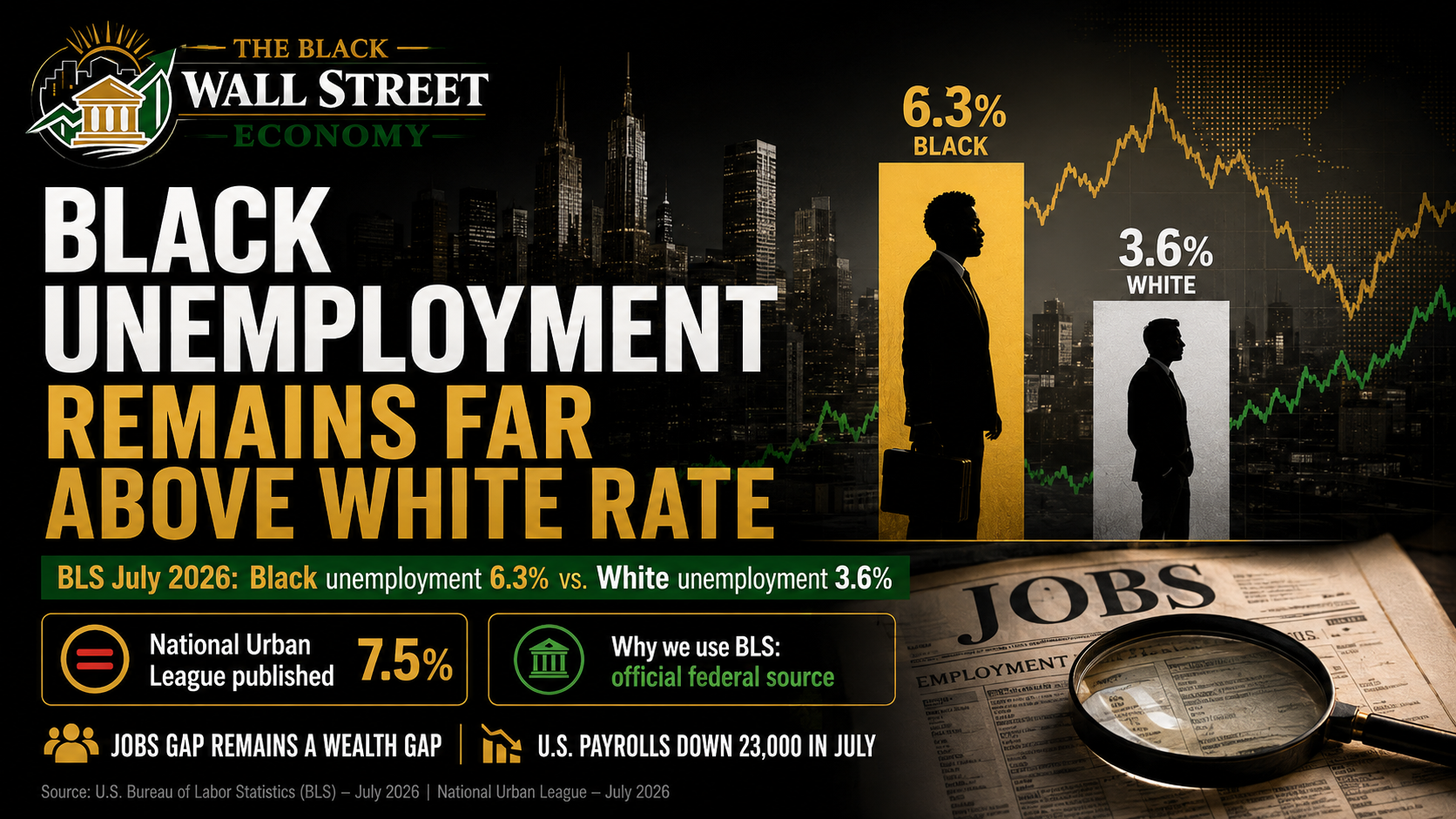
According to the latest official employment data released Friday, August 7, by the U.S. Bureau of Labor Statistics, the unemployment rate for Black or African American workers stood at 6.3% in July 2026.
The unemployment rate for white Americans was 3.6%, while the overall national unemployment rate stood at 4.1%.
That means the Black unemployment rate was approximately 75% higher than the white unemployment rate, underscoring a persistent employment gap with major implications for income, savings, homeownership, retirement and long-term wealth creation.
But another number is now circulating.
National Urban League Reports 7.5%
In an article published Sunday, August 9, the National Urban League reported that the Black unemployment rate had risen to 7.5%, while putting white unemployment at 3.7%.
The Urban League article states that Black employment declined by 7,000 workers and describes the Black-to-white unemployment ratio as approximately two-to-one.
Those figures, however, do not match the latest official July 2026 figures published by the Bureau of Labor Statistics.
The difference is significant.
A Black unemployment rate of 7.5% versus 6.3% represents a difference of 1.2 percentage points. That is too substantial for Black Wall Street News to simply report both figures without examining which number should be treated as the current official rate.
There are other inconsistencies as well.
The National Urban League article says the national unemployment rate was 4.3% and describes employment increasing by 22,000 jobs. The official August 7 BLS report, however, states that the national unemployment rate was 4.1% in July and that total nonfarm payroll employment declined by 23,000 jobs.
Those differences indicate that the Urban League article is not presenting the same set of figures contained in the current BLS July 2026 Employment Situation report.
Black Wall Street News could not determine from the National Urban League article itself why the figures differ. The article does not clearly explain whether the 7.5% figure represents a different reporting period, an earlier data set, a separate calculation or information carried over from another employment report.
Therefore, until the National Urban League provides clarification, Black Wall Street News is using 6.3% as the current official Black unemployment rate for July 2026.
Why We Are Using the BLS Number
The decision to use the Bureau of Labor Statistics figure is not a judgment against the National Urban League or its work.
It is a question of primary source versus secondary source.
The Bureau of Labor Statistics is the federal statistical agency responsible for producing the nation's official employment and unemployment statistics.
The Black unemployment figure comes from the Current Population Survey, commonly called the household survey. Approximately 60,000 scientifically selected households participate in the survey each month, and the data are used to determine employment, unemployment and labor-force participation across demographic groups, including race and ethnicity.
The National Urban League, by contrast, is an advocacy and civil-rights organization. It analyzes economic conditions and their effects on Black Americans, but it is not the government agency that produces the nation's official unemployment statistics.
In fact, the National Urban League itself references Bureau of Labor Statistics data in its employment commentary.
When a secondary organization reports a figure that conflicts with the agency that actually produced the underlying government statistics, the responsible journalistic practice is to return to the original source data.
For that reason, Black Wall Street News is reporting the BLS figure of 6.3% while also publicly acknowledging that the National Urban League has published a conflicting figure of 7.5%.
That does not mean BLS numbers are perfect or beyond scrutiny.
The Current Population Survey is a statistical survey rather than a literal count of every American worker, and BLS itself acknowledges that its estimates are subject to sampling and nonsampling error.
Economic statistics can also be revised as more information becomes available.
But as of August 9, the official federal figure for Black unemployment in July 2026 is 6.3%.
Whether It Is 6.3% or 7.5%, the Larger Problem Remains
The disagreement over the exact number should not obscure the larger economic issue.
Even using the lower and currently official 6.3% BLS figure, Black Americans continue to experience unemployment at a dramatically higher rate than white Americans.
The current numbers are:
Black unemployment: 6.3%
White unemployment: 3.6%
Overall U.S. unemployment: 4.1%
In July 2025, Black unemployment stood at 7.2%. It declined to 6.6% in both May and June 2026 before declining again to 6.3% in July. White unemployment remained at 3.6% in July.
So while the latest month shows some improvement in the Black unemployment rate, the racial employment gap remains considerable.
And that gap is not simply about jobs.
It is about wealth.
Unemployment Becomes a Wealth Issue
Every period without employment can mean lost wages, reduced retirement contributions, depleted savings, increased credit-card debt and difficulty qualifying for mortgages and business financing.
For households already working to build or preserve wealth, unemployment can have effects lasting far beyond the weeks or months that a person remains without a job.
That is why employment data should matter to the Black business and financial community.
A worker who loses a paycheck may stop contributing to a 401(k).
A family may postpone buying a home.
An aspiring entrepreneur may use business capital to cover household expenses.
A homeowner may fall behind.
A parent may no longer be able to contribute to a child's education fund.
And a household that might otherwise be accumulating assets can instead find itself liquidating them.
This is how a jobs gap can become a wealth gap.
Payrolls Declined in July
The broader American labor market also showed signs of weakness in July.
According to BLS, total nonfarm payroll employment declined by 23,000 jobs during the month. Employment declined in local government education and retail trade, while health care continued to add jobs.
The decline deserves attention because slowing employment growth can affect communities unevenly.
Historically persistent disparities mean that national economic statistics that appear relatively modest can have a much greater impact within communities where unemployment is already elevated.
For Black America, a 4.1% national unemployment rate therefore does not tell the entire story.
The more relevant number is 6.3%.
Black America Should Watch the Numbers — and Their Sources
The discrepancy between the Bureau of Labor Statistics and the National Urban League also illustrates something increasingly important in today's information environment: consumers need to know where economic numbers originate.
Organizations, commentators, financial institutions, political groups and media outlets frequently interpret government statistics.
Those interpretations can be valuable.
But interpretation and data collection are not the same thing.
When conflicting numbers appear, readers should identify the primary source, determine what period is being measured and examine whether the figures are seasonally adjusted, revised or drawn from a different data set.
In this case, the most current official BLS release dated August 7 establishes the July 2026 Black unemployment rate at 6.3%.
Until additional information explains the National Urban League's 7.5% figure, Black Wall Street News believes the responsible figure to publish as the official rate is 6.3%.
But whether the rate is 6.3% or even higher, the economic warning remains clear:
Black unemployment continues to substantially exceed white unemployment.
For Black America, that is more than a labor statistic.
It is a financial statistic.
It affects who earns, who saves, who invests, who qualifies for financing, who owns property, who starts businesses and ultimately who has the opportunity to build and transfer wealth to the next generation.
And that is why the Black unemployment rate deserves to be watched just as closely as the Dow Jones Industrial Average, interest rates, inflation or the price of a home.
Written by The Black Wall Street Economy newsroom. Facts reported by The Black Wall Street Economy.
Before you go
Subscribe to the weekly newsletter
One email a week: the stories, numbers, grants, and contracts that move Black household and business wealth — plus an action step you can take that week. Free, and you can unsubscribe anytime.
More in Jobs
Charlie Kirk's Economic Impact on Black America
September 15, 2026
Racism Claims and Workplace Discipline: A Canadian Nurse's Case
September 15, 2026
Black Workers' Bias Lawsuit Against Restaurant Proceeds
September 3, 2026
Black Starbucks Worker Sues, Citing Hairstyle Discrimination
September 3, 2026